Healthy hips are not simply flexible hips. They need enough freedom to move, enough strength to support you and enough control to respond to the horse.
Your hips sit at the centre of almost everything you do in the saddle.
They influence how your pelvis sits.
How your legs drape.
How evenly you bear weight through both seat bones.
How well you absorb movement.
And how easily you can use one leg without the rest of your body becoming involved.
When the hips feel restricted, weak or uneven, riding can become much harder than it needs to be.
You may notice:
- tightness through the lower back
- discomfort around the hips
- bouncing in sitting trot
- one leg creeping forward
- uneven pressure through the stirrups
- difficulty sitting evenly
- one rein feeling easier than the other
But healthy hips are not created by stretching alone.
A hip can feel tight because it lacks suppleness.
It can also feel tight because it lacks strength, control or security.
Sometimes the body creates tension because it does not feel supported within a position.
That is why the goal is not simply to make your hips looser.
The goal is to help them become more supple, strong and organised.
What Healthy Hips Need
The hip is a ball-and-socket joint, which gives it the potential to move in many directions.
When you ride, the thigh bones need to move within the hip sockets while the pelvis remains balanced above them.
This requires freedom through the muscles around the hips.
But it also requires strength.
Without enough suppleness, the pelvis may be pulled, tipped or twisted as the legs move.
Without enough strength and control, the body may grip, brace or search for stability elsewhere.
The thighs tighten.
The knees pinch.
The lower back works harder.
The hands may become busier.
This is why I often describe the quality we need as elastic strength.
Your body is supported, but not rigid.
Your hips are free, but not unstable.
Your muscles can work without holding on harder than necessary.
That combination is what helps create a softer, more balanced rider.
Position Is the Outcome
Many riders try to improve their leg position by forcing the leg into place.
They push the heel down.
Turn the toe inward.
Pull the thigh back.
Or try to sit more deeply.
But the position of the leg is often an outcome of what is happening at the hip.
If the front of the hip is restricted, the leg may creep forward.
If the thigh rotates outward, the knee and toe may follow.
If one hip is tighter or less stable, one side of the pelvis may shift or feel heavier.
Trying to fix the final position without improving the function underneath it can create more tension.
Instead of asking:
How do I hold my leg here?
It may be more useful to ask:
Does my hip have the freedom and strength to allow this position?
When the body has better options, alignment often improves with less effort.
Why Hips Become Tight
Riding itself is not the only influence on your hips.
Your body brings the rest of your life into the saddle.
Many of us spend hours sitting at desks, driving or looking down at devices.
We cross one leg over the other.
Lean onto one hip.
Stand with more weight on one side.
Carry bags on the same shoulder.
Repeat the same movements every day.
Over time, these habits can create differences between the left and right sides.
One hip may rotate more freely.
One side may feel stronger.
One leg may naturally carry more weight.
Previous injuries can also influence how your body organises itself, even years later.
This is why so many riders notice one side is easier.
One stirrup feels shorter.
One leg feels more secure.
One rein feels more coordinated.
The aim is not to become perfectly symmetrical.
We all have asymmetries.
The goal is to understand your patterns and improve the differences that interfere with your balance, comfort and ability to communicate clearly.
Build Suppleness and Strength
Suppleness work helps create more space around the hips.
It can improve your ability to:
- allow the thighs to drape
- sit more evenly
- follow the horse’s movement
- move one leg without taking the pelvis with it
- reduce unnecessary tension through the lower back
- access a more comfortable riding position
For many riders, especially those returning to exercise or feeling stiff, this is the easiest place to begin and why we created the hip suppleness program, just 15 minutes a day.
You feel a change.
The hips feel less restricted.
The saddle feels different.
You may notice one seat bone more clearly or feel the leg hang more naturally.
Those changes are valuable.
But they are only the first step.
Suppleness opens the door. Strength helps you live there.
Why Stretching Is Not Enough
Stretching may give you more range, but your body needs to feel supported inside that range.
Otherwise, it may quickly return to the position it knows best.
This is one reason a rider can stretch every day and still feel tight in the saddle.
The body may have more movement available, but it does not yet have enough strength or control to use it confidently.
The body returns to what it can support.
So once you create more freedom, you need to strengthen within that new range.
This helps the body trust the position.
It also reduces the need to grip or brace for stability.
A balanced program should include both:
- suppleness work to create more room
- strength work to help your body control and support that room
Strength Around the Hips
The muscles around the hips do not work in isolation.
Your glutes, inner thighs, outer hips, quadriceps, hamstrings and trunk all contribute to the position and control of the pelvis and legs.
For riders, exercises that bring these areas together can be particularly useful.
They help you develop strength that transfers into real movement rather than training one muscle in isolation.
Useful patterns include:
- squats
- lunges
- step-ups
- bridges
- single-leg bridges
- split squats
- controlled toe taps
- hip hinges
- single-leg deadlifts
The aim is not simply to lift more weight.
It is to maintain good alignment while the hips and legs move.
Can you keep the pelvis level?
Can you breathe?
Can you control the movement on both sides?
Can you feel one side doing more than the other?
These details matter.
Why Single-Leg Work Matters
Riding is symmetrical in theory, but the body is not always symmetrical in practice.
Many riders rely more heavily on one leg.
This becomes particularly obvious during rising trot.
Ask yourself:
Are you pushing evenly through both stirrups?
Do you rise more strongly from one leg?
Does one hip move more easily?
Does one side of your pelvis feel more stable?
Exercises that work one side at a time make these differences much easier to feel.
They also prevent the stronger side from quietly taking over.
Single-leg bridges, lunges, split squats, step-ups and single-leg hinges can all help develop:
- left-to-right awareness
- pelvic control
- hip stability
- balance
- strength through each leg independently
This can support clearer leg aids and a more even seat.
Train the Supporting Muscles
The glutes are often discussed as though riders simply need to strengthen them more.
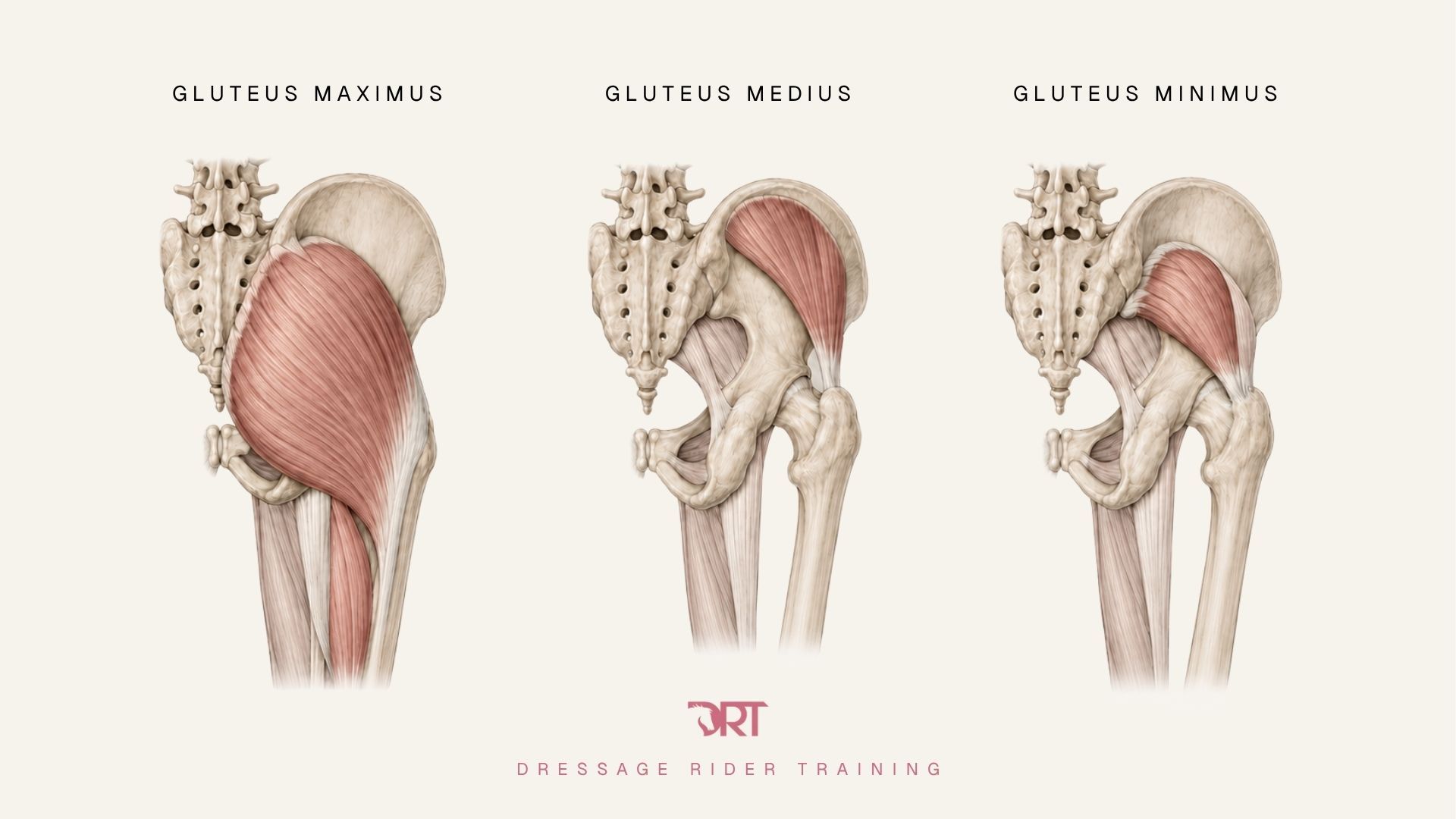
But strength is only part of the picture.
Your glutes need to contribute at the right time and in the right amount.
If they are weak or poorly coordinated, the front of the hips and lower back may work harder.
If you clench them constantly in the saddle, the pelvis may become stiff and less able to follow the horse.
The goal is not permanently switched-on glutes.
It is responsive glutes.
They help support the pelvis and control the hip when needed, then allow the body to remain available.
Again, this is elastic strength.
Inner and Outer Hips
The muscles at the sides of the hips help control the pelvis and thigh bones.
They influence whether the leg collapses inward, rotates outward or remains organised beneath you.
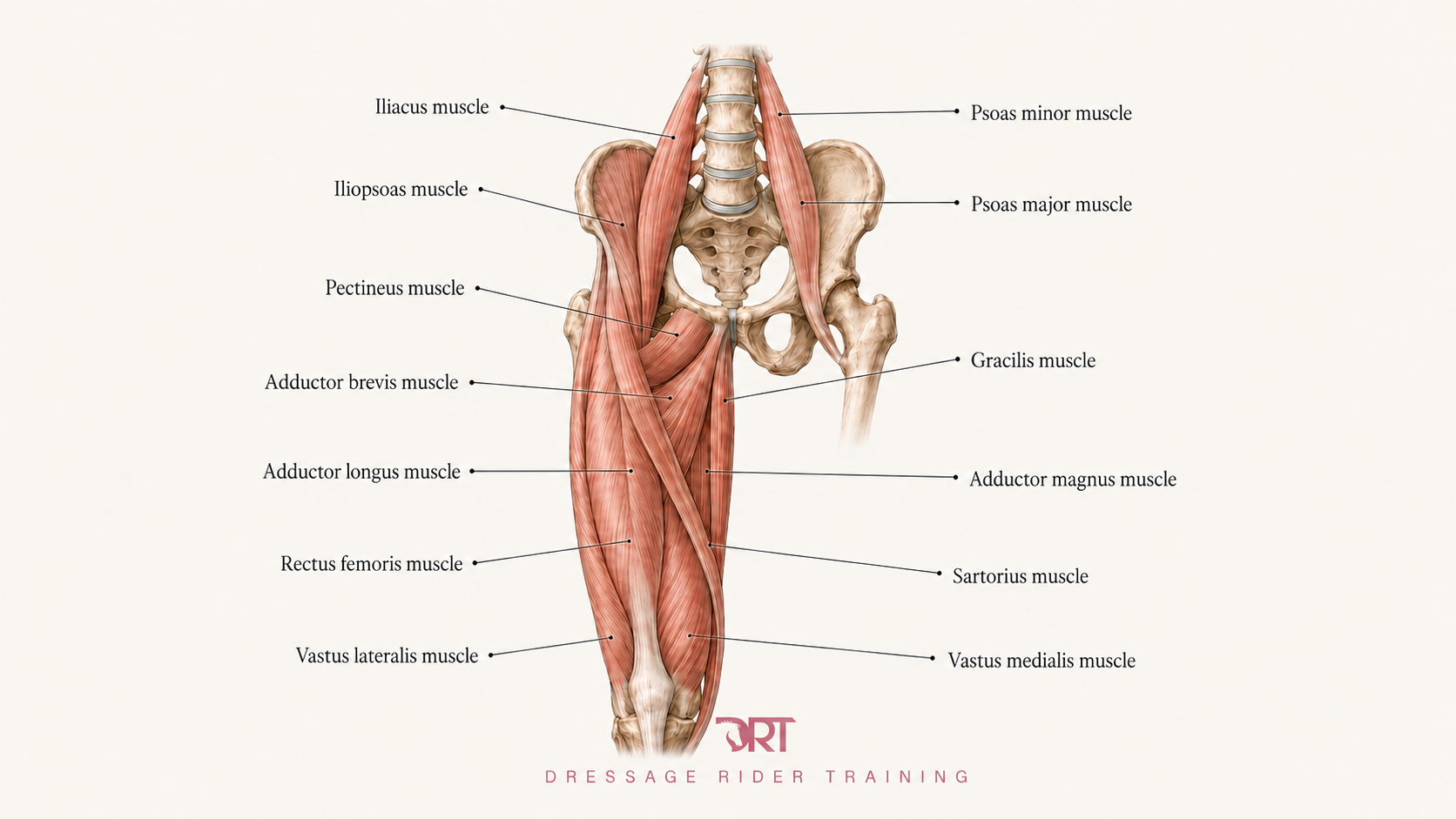
The inner thighs also contribute to leg control, but riders often overuse them by gripping.
This can make the hips feel even more restricted.
The goal is to strengthen both the inner and outer hips without teaching the body to clamp.
Controlled movements are often more useful than simply squeezing harder.
Your legs should be able to rest around the horse with support, not hold you on through constant tension.
Use Movement Variety
Your hips are designed to move in several directions.
They flex and extend.
Rotate inward and outward.
Move away from and toward the centre of the body.
A good hip routine should reflect this.
If you only stretch in one direction or repeat the same exercise, you may miss areas that influence your riding.
A useful routine can include:
- opening the front of the hips
- working on inner-thigh suppleness
- improving rotation
- strengthening hip extension
- developing control through the outer hips
- moving one leg while keeping the pelvis organised
You do not need a long or complicated session.
A few well-chosen exercises performed consistently can make a meaningful difference.
Notice Your Hips at Walk
When you first get on, use the walk as an opportunity to check in with your body.
Notice:
Can you feel both seat bones?
Does one hip move more easily?
Is one thigh gripping?
Does one leg hang farther forward?
Are your toes clenched?
Is your lower back trying to create the movement your hips are not allowing?
You do not need to fix everything immediately.
Begin by noticing.
Awareness helps you connect what you feel off the horse with what happens in the saddle.
You may discover that a restriction you noticed during an exercise is the same pattern affecting your riding.
That is where off-horse training becomes useful rather than separate from your riding.
Do Not Force the Range
More suppleness is not always better.
You do not need extreme flexibility to ride well.
You need enough freedom for your body, saddle, horse and goals.
Forcing stretches can create irritation or make the body feel less secure.
Aim for a controlled, manageable sensation rather than pushing to the end of your range.
You should be able to breathe.
Your muscles should gradually settle.
You should not feel sharp pain, pinching or pressure in the joint.
Healthy hips are not the most flexible hips.
They are hips that can move comfortably and be controlled through the range available.
Your Healthy-Hip Plan
Your hips are not a project you complete and never revisit.
They will change with age, workload, injury, riding volume and daily habits.
Some seasons you may need more suppleness work.
Other times you may need to prioritise strength.
You may discover a new asymmetry when you ride a different horse or work at a higher level.
That is normal.
Your seat and body are not final destinations you arrive at.
They are lifelong areas of development.
The more awareness you build, the sooner you can respond when something begins to feel restricted, weak or uneven.
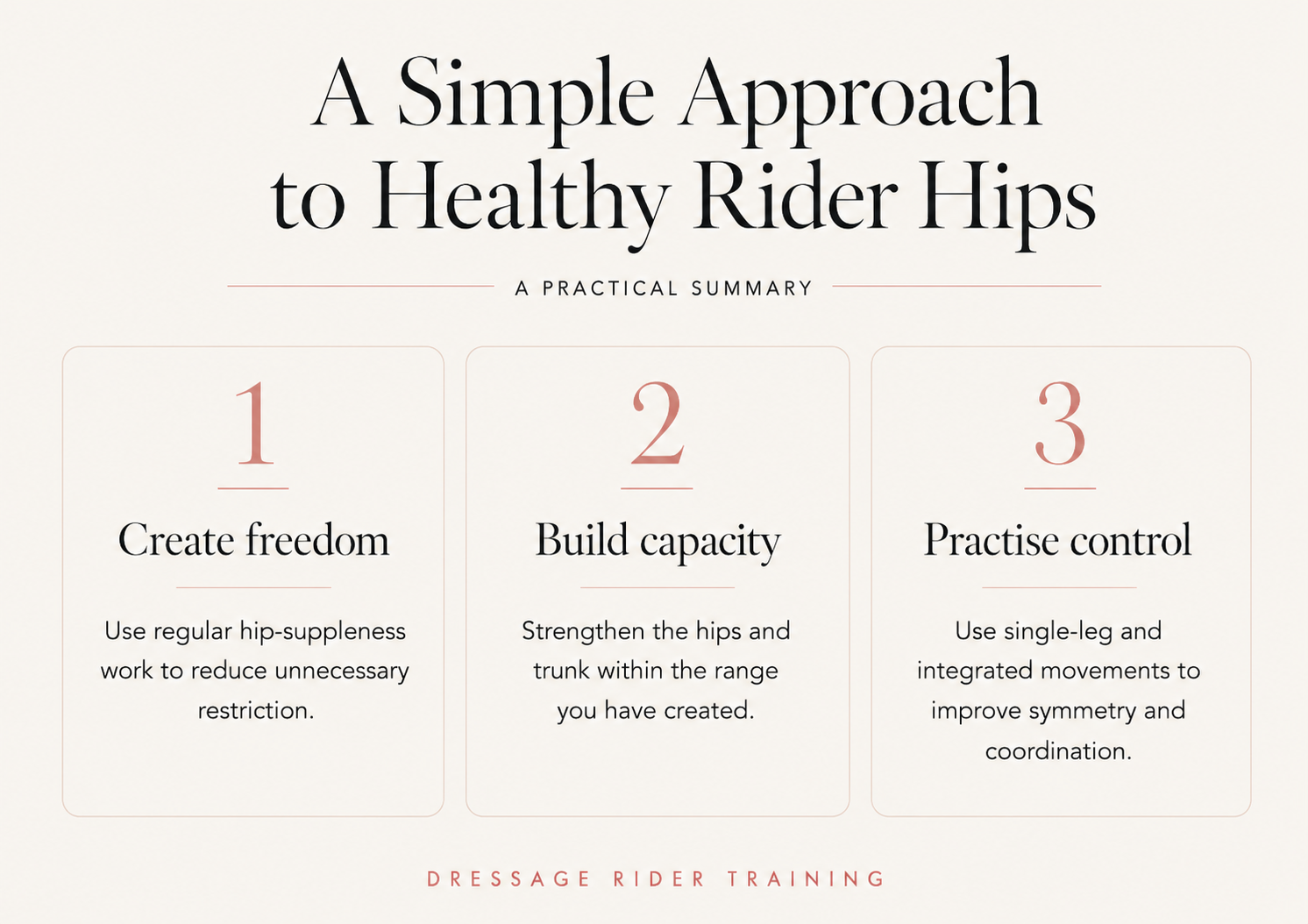
A Simple Approach
A good place to begin is:
First, create more freedom.
Then, build strength within that freedom.
Finally, practise using that range with control.
This might mean completing a short hip-suppleness routine before riding, then including lunges, bridges or single-leg exercises in your weekly strength work.
Consistency matters more than intensity.
You do not need to exhaust yourself.
You need to give your body repeated opportunities to move well.
Healthy Hips Create Options
The goal of hip training is not to chase a perfect riding position.
It is to give your body more choices.
More room to follow the horse.
More strength to remain balanced.
More control to use each leg independently.
More awareness of your asymmetries.
And less need to grip, brace or compensate.
When your hips are supple enough to move and strong enough to support you, the whole body can begin to soften.
Your seat feels more available.
Your legs can drape more naturally.
Your pelvis can respond without becoming unstable.
And riding can begin to feel less like something you are holding together and more like a movement you are part of.
Improve Your Hips Off the Horse
Inside Dressage Rider Training, we use rider-specific hip suppleness and strength work to improve the way your hips, pelvis and legs function together.
The aim is not to make you extremely flexible or rigidly strong.
It is to help you create a body that is organised enough to soften, strong enough to remain balanced and free enough to move with your horse.
Because healthy hips are not simply loose hips.
They are supple, strong, responsive and supported.