A short rider-specific sequence to help your hips, inner thighs and spine feel more available before you get in the saddle
Some days, your body arrives at the mounting block ready to move.
Other days, it does not.
You may have spent hours sitting at a desk.
Driven a long distance.
Ridden several horses already.
Or simply woken up feeling tighter than usual through your hips, inner thighs or back.
Then you get on your horse and expect your body to immediately become soft, balanced and responsive.
That is quite a transition.
Your horse gets a warm-up.
Your body often needs one too.
This short routine uses five movements from our pre-ride warm up series.
- Hip Flexor to Hamstring Flow
- Lunge and Rotation
- Half-Kneeling Adductor Rock Back
- Wide-Leg Thoracic Rotation
- Squat to Hamstring Stretch
Together, they help prepare the areas riders rely on most: the front and inside of the hips, the backs of the legs, the pelvis and the upper spine.
The aim is not to stretch as far as possible.
It is to help your body feel warmer, freer and more available before you ride.
Why Your Body May Need a Pre-Ride Reset
Riding asks your body to move in ways that are quite different from everyday life.
Your hips need to open around the horse.
Your thigh bones need to move within the hip sockets.
Your pelvis has to respond to the horse beneath you.
Your spine needs enough support to remain organised, while still allowing subtle movement.
Your inner thighs, knees and ankles need to remain available rather than fixed.
When you have spent hours sitting, driving or repeating the same daily positions, these areas may not immediately feel ready.
You might notice:
- one hip feels tighter than the other
- your thighs grip as soon as you mount
- your lower back begins doing too much
- one leg hangs differently
- your seat feels uneven
- your upper body feels stiff
- your body takes half the ride to settle
A five-minute warm-up will not solve every restriction.
But it can help your body move out of the posture it has held all day and begin preparing for the posture and movement riding requires.
That transition matters.
Sometimes your body does not need to try harder.
It simply needs a little movement before you ask more from it.
Dynamic Suppleness Before You Ride
Before riding, I prefer movement-based suppleness work rather than forcing long, deep stretches.
A pre-ride routine should help you feel more awake and available—not fatigued or overstretched.
Move slowly through each exercise.
Stay within a range you can control.
Take one or two breaths in each position, or perform several gentle repetitions where the exercise flows.
You should finish feeling more prepared than when you began.
1. Hip Flexor to Hamstring Flow
This movement alternates between opening the front of the hip and lengthening the back of the front leg.
It is particularly useful after long periods of sitting, when the hips and hamstrings can both feel reluctant to move.
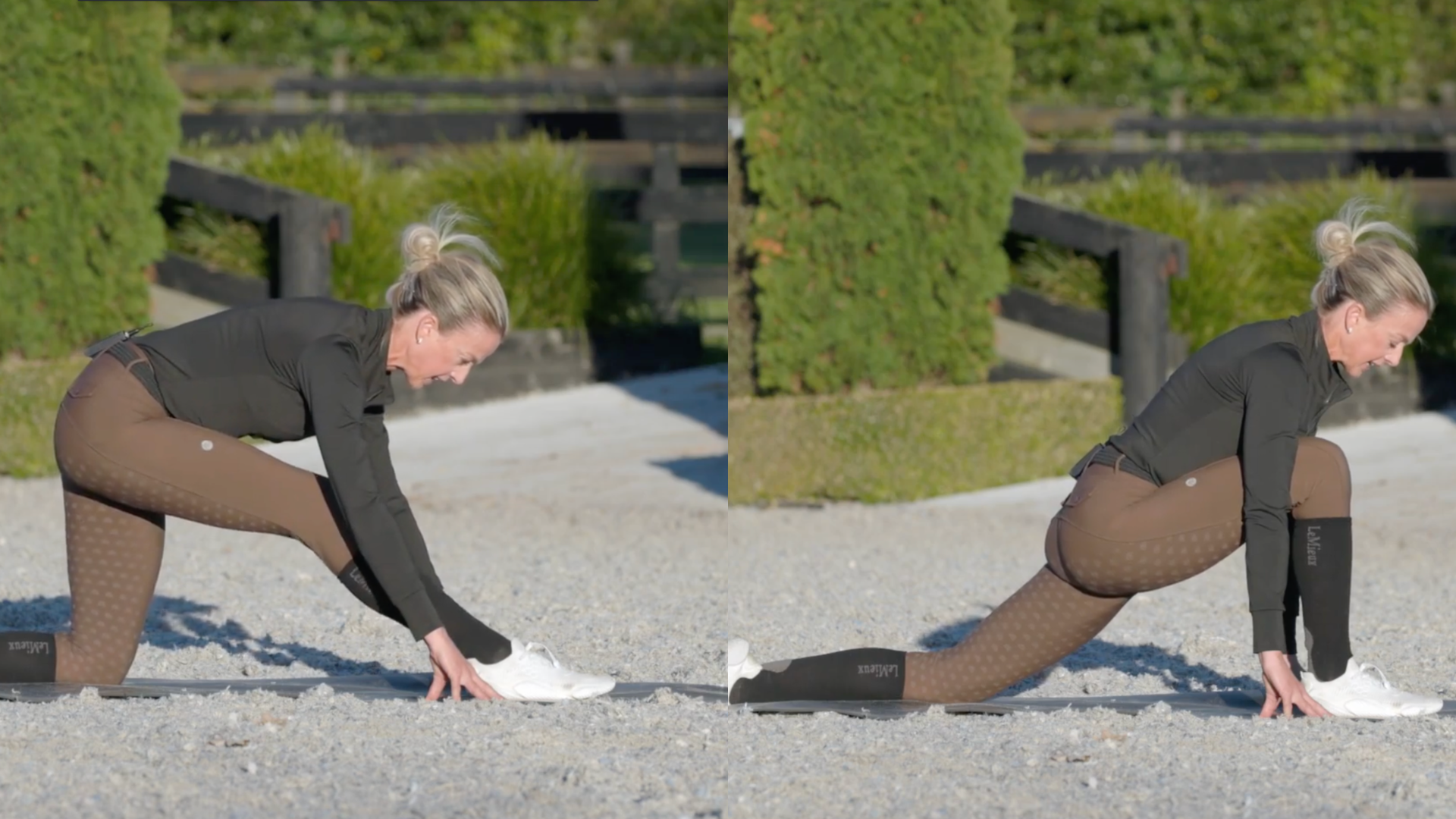
Begin in a half-kneeling position with one foot in front and the opposite knee supported on the floor.
Organise your pelvis so you are not arching heavily through your lower back.
Gently shift your hips forward until you feel a manageable stretch through the front of the back hip.
Then send your hips backward and begin straightening the front leg.
Keep the spine long and hinge from the hips.
Return to the lunge and continue moving smoothly between the two positions.
Complete approximately five or six slow repetitions before changing sides.
What to notice
Can you move forward without arching your lower back?
Can you shift backward without collapsing through your spine?
Does one side feel much tighter?
Can your pelvis remain relatively organised as the hip changes position?
The aim is not maximum range.
It is to create movement through the hip and back of the leg without borrowing that movement from the lower back.
2. Lunge and Rotation
The lunge and rotation combines hip opening with movement through the upper spine.
This is valuable for riders because the torso needs to remain responsive while the pelvis and legs work beneath it.
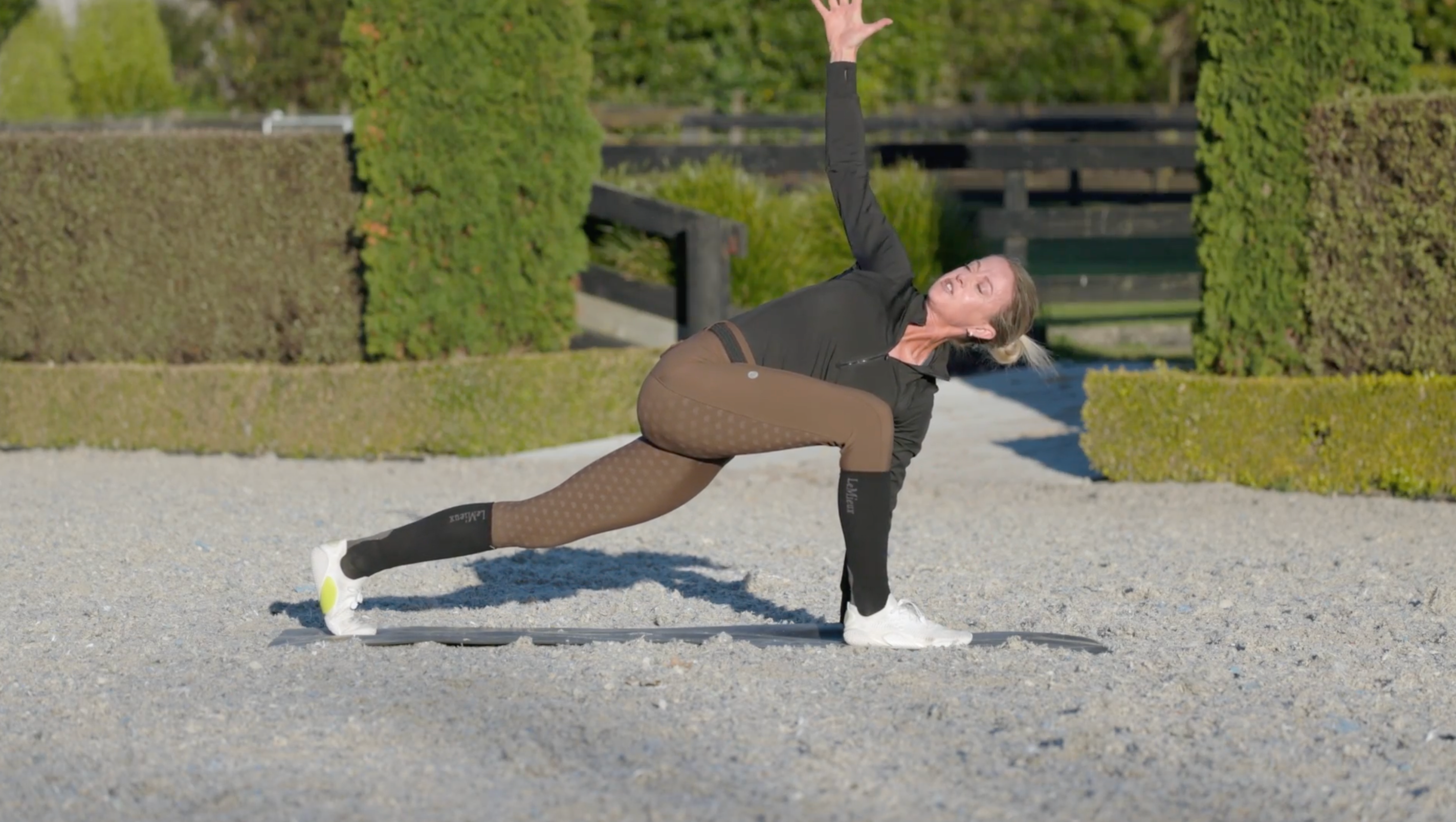
Begin in a half-kneeling lunge.
Place one hand on the wall or keep it in front of you for balance, depending on the version shown in the video.
Rotate your upper body toward the front leg and reach the opposite arm open.
Allow your chest and eyes to follow the movement.
Return slowly to the centre.
Repeat five or six times before changing sides.
What to notice
Can the movement come from your upper back rather than forcing your lower back to twist?
Can you keep the pelvis relatively steady?
Does one side rotate more easily?
Can you continue breathing as you turn?
Your goal is not to create the biggest rotation possible.
You are simply reminding the upper spine that it is allowed to move independently of the pelvis.
3. Half-Kneeling Adductor Rock Back
This movement helps create more freedom through the inner thigh while teaching the hips to move without the spine collapsing.
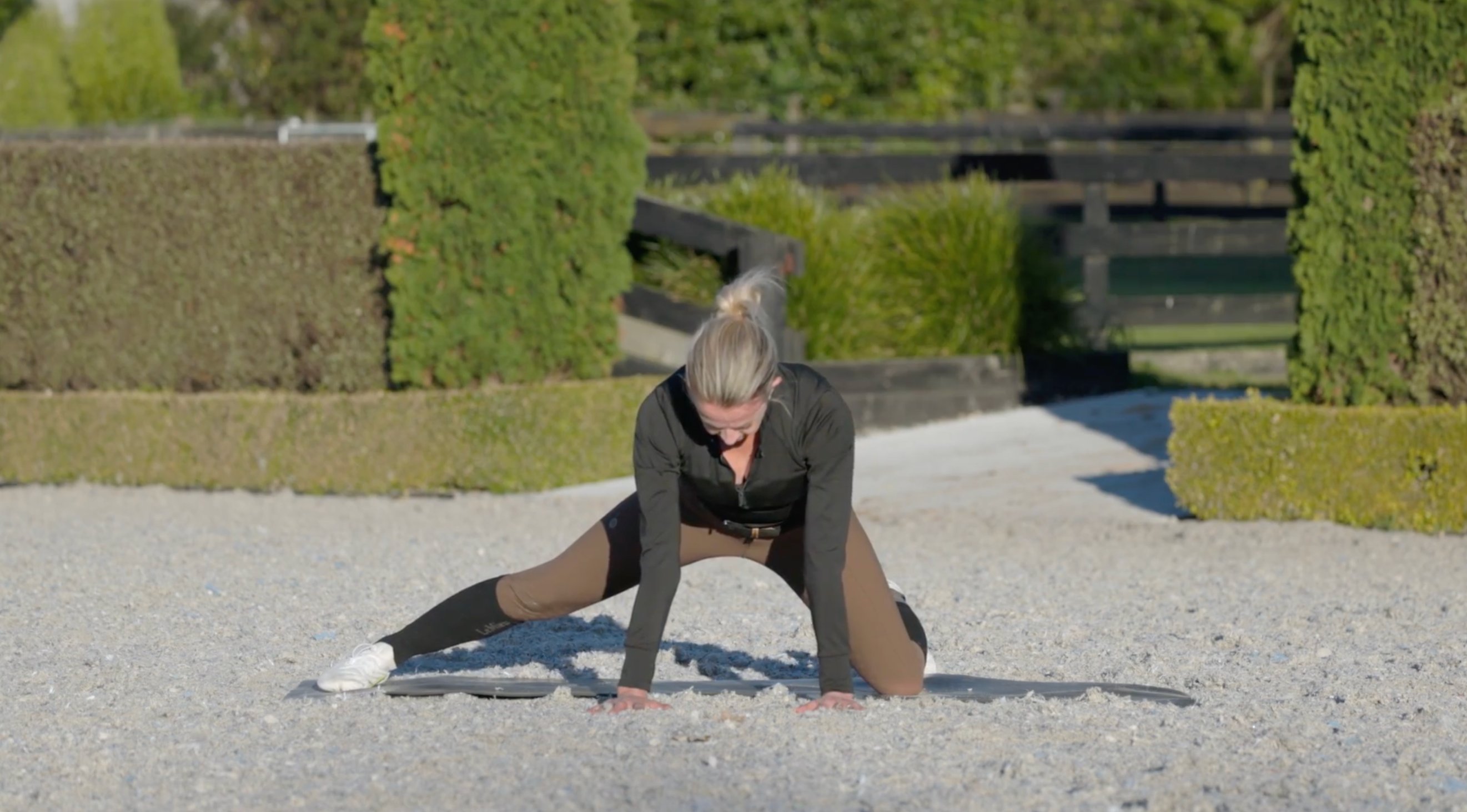
Begin on one knee.
Extend the opposite leg out to the side with the foot supported on the floor.
Keep your hands on the wall, the floor or another stable surface.
Maintain a long spine as you slowly send your hips backward.
Move until you feel a stretch through the inner thigh of the extended leg.
Then return to the starting position.
Repeat approximately six to eight times before changing sides.
What to notice
Can you send the pelvis backward without rounding your whole back?
Does one inner thigh feel significantly tighter?
Can you keep the extended foot and knee comfortably aligned?
Can the hip move without the pelvis twisting?
The inner thighs need enough suppleness to allow the legs to drape around the horse.
But the movement should remain controlled.
Do not force the leg farther out than you can comfortably support.
4. Wide-Leg Thoracic Rotation
This movement combines a wide hip position with rotation through the upper spine.
That makes it particularly relevant for riders, who need to sit with the thighs apart while maintaining freedom through the ribcage and shoulders.
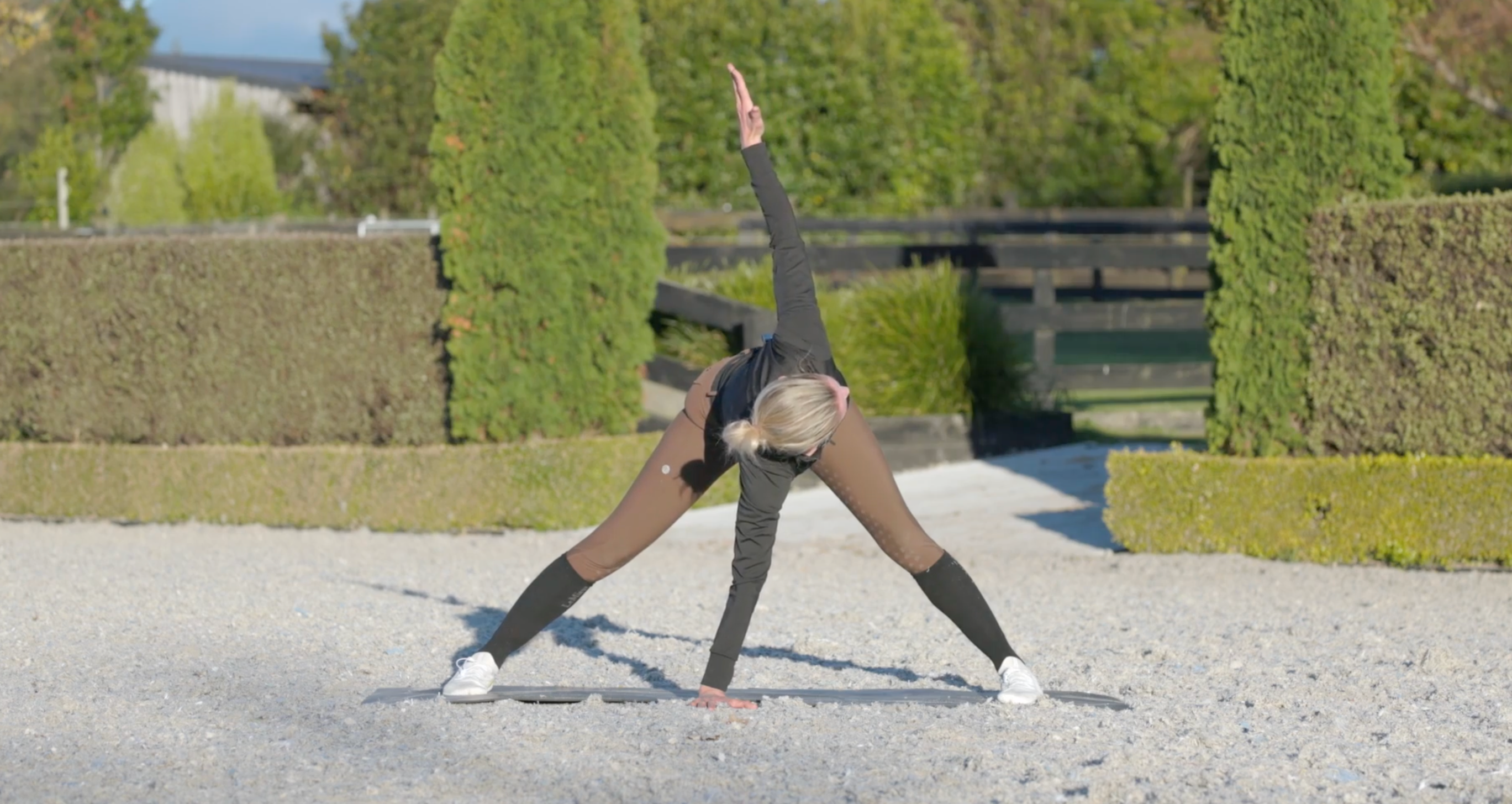
Stand with your feet comfortably wide.
Soften the knees and hinge forward slightly from the hips.
Place one hand on the wall, floor or a support in front of you.
Rotate the opposite arm toward the ceiling, allowing the chest to follow.
Return with control and repeat on the other side.
Continue for approximately five repetitions each way.
What to notice
Can you maintain the wide position without the knees collapsing inward?
Can your upper spine rotate without the pelvis turning with it?
Does one direction feel more restricted?
Can you keep the neck relaxed?
This movement should create a sense of width and rotation—not strain through the lower back.
5. Squat to Hamstring Stretch
The final movement takes the hips and knees through a squat before lengthening the backs of the legs.
It helps warm the lower body while also creating more freedom through the hamstrings.
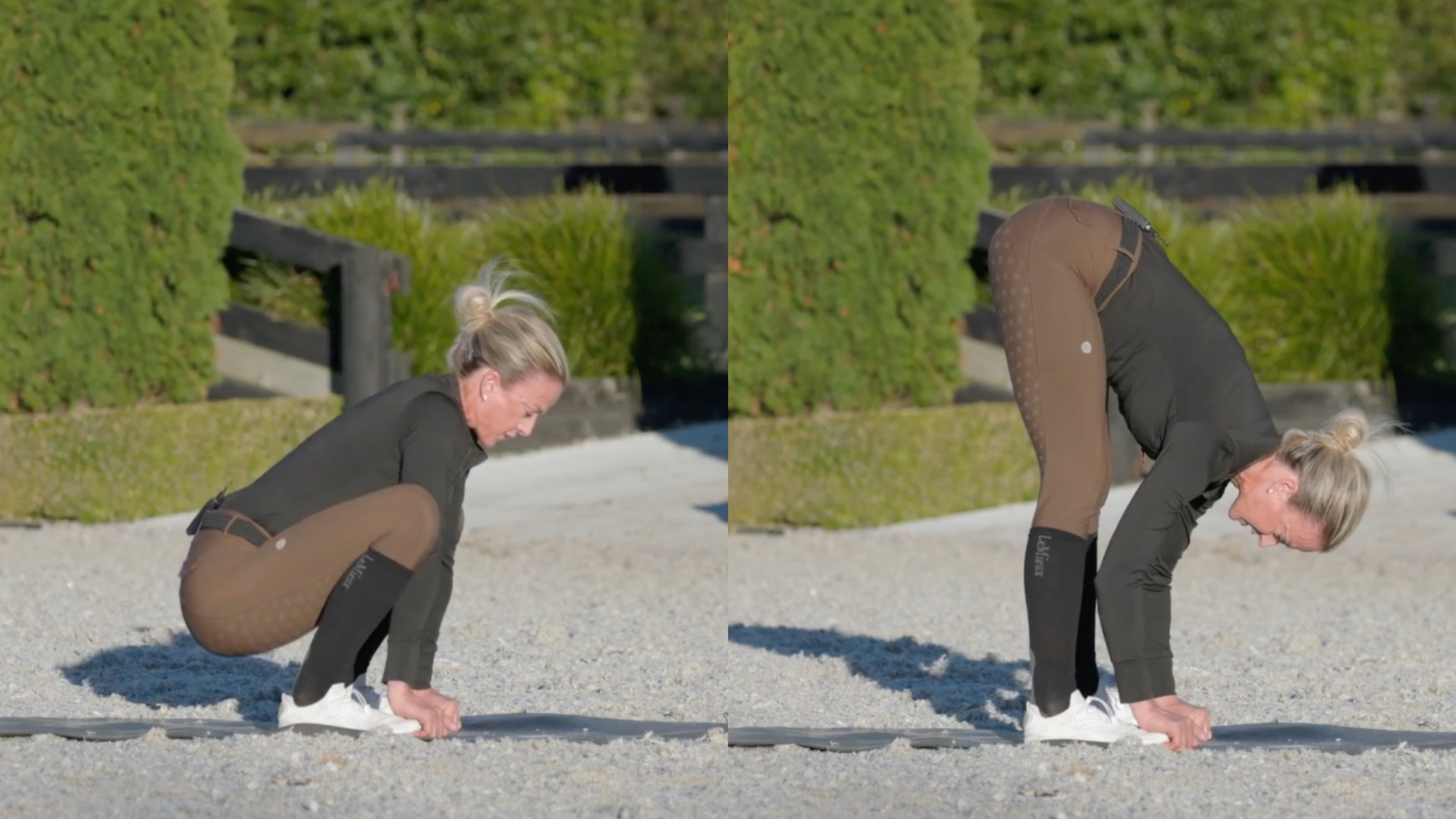
Stand with your feet slightly wider than hip-width apart.
Lower into a comfortable squat, using the wall for support if needed.
Keep your chest lifted and allow the hips to descend only as far as you can control.
Then lift the hips and begin to straighten the legs, allowing the torso to fold forward into a hamstring stretch.
The knees may remain slightly bent.
Return to the squat and continue flowing between the two positions.
Complete five to eight slow repetitions.
What to notice
Can you keep your feet grounded in the squat?
Does one hip shift more than the other?
Can you lift the hips without locking the knees?
Can you feel the backs of the legs lengthen without forcing the stretch?
This movement should gradually warm the legs rather than become a test of squat depth or flexibility.
Bring the Movements Together
Once you understand each exercise, move through them as a short sequence:
- Hip Flexor to Hamstring Flow
- Lunge and Rotation
- Half-Kneeling Adductor Rock Back
- Wide-Leg Thoracic Rotation
- Squat to Hamstring Stretch
Complete the first three movements on both sides.
Then finish with the two standing movements.
You do not need to perform a large number of repetitions.
Five or six controlled repetitions of each exercise is enough for a short pre-ride reset.
The entire routine can take less than five minutes once you know the sequence.
Move steadily.
Keep breathing.
Let the range develop gradually rather than chasing it.
You are looking for a small but useful shift:
Your hips feel less restricted.
Your inner thighs feel more available.
Your spine rotates more easily.
Your legs feel warmer.
Your balance feels clearer.
And your body feels less surprised when you get into the saddle.
When This Routine Is Most Useful
You do not need to complete the entire routine before every ride.
Some days, stable work, walking and your normal riding warm-up may be enough.
But this sequence can be especially useful when you have:
- spent hours sitting
- driven for a long time
- travelled by plane
- woken up feeling stiff
- had time away from riding
- trained hard the previous day
- noticed one hip or inner thigh feeling restricted
- felt crooked or braced during recent rides
Use it as a response to what your body needs rather than another rule you must follow.
Your body will not feel exactly the same every day.
Some days you may use the entire sequence.
Other days you may choose only two movements.
The more awareness you develop, the easier it becomes to recognise what will help.
Do Not Turn Your Warm-Up Into a Flexibility Test
You may notice one side feels much tighter.
Your balance may be poor.
A movement that felt easy last week may feel restricted today.
That does not mean the routine is not working.
It means your body is giving you information.
Do not force the tighter side to match the easier one.
Do not push through sharp pain or pinching.
And do not judge your readiness to ride by how far you can stretch.
The aim is preparation.
Not perfection.
You want to finish feeling warmer, more aware and more available—not exhausted or irritated.
Take the Feeling Into the Saddle
Once you mount, pause for a moment before asking for more.
Notice what has changed.
Can you feel both seat bones more clearly?
Do your thighs settle around the horse with less effort?
Does one hip still feel tighter?
Can your ribcage and shoulders move without taking your pelvis with them?
Do your legs feel warmer and more responsive?
The off-horse warm-up is not separate from the ride.
It gives you a chance to notice your own body before the horse’s movement adds another layer.
That awareness helps you make better choices.
Instead of forcing your position, you can recognise where your body may need more time.
Instead of immediately blaming your riding, you can notice whether you arrived stiff, tired or asymmetrical.
That is useful information.
Five Minutes Can Still Make a Difference
It is easy to believe that unless you have time for a complete workout or a long stretching session, there is little point doing anything.
But small routines matter.
Five minutes can help you shift out of the positions you have been in all day.
It can improve your awareness of left and right.
It can help your hips and spine feel more available.
And it can remind you that your body is one half of the riding partnership.
You do not need to arrive in the saddle perfectly supple.
You simply want to arrive more prepared than you were five minutes earlier.
A Pre-Ride Warm-Up Is Not the Whole Answer
This routine can help your body feel better before a ride.
But if the same areas feel restricted every day, your body may need more than a short reset.
It may need consistent work away from the horse.
A few minutes of suppleness work can create temporary room.
Rider-specific strength helps you support and control that room.
Suppleness opens the door. Strength helps you live there.
The goal is not to become extremely flexible.
It is to have enough freedom to follow your horse and enough strength to remain organised while you do it.
Build a Body That Is Ready to Ride
Our Hip Suppleness Program was created to help riders improve the freedom, symmetry and awareness that influence how they sit and move in the saddle.
The short sessions give you a practical way to work on the areas that repeatedly feel tight—without needing to spend hours stretching.
Then, once you have created more availability, rider-specific strength work helps you build the capacity to support it.
Because the best pre-ride routine is useful.
But the bigger goal is to create a body that needs less preparation to feel available.